Word MindSort: Solitaire
- 4.5
- Rating
- 500.00K
- Installs
- Free
- Price
 Analysis by App-foxy
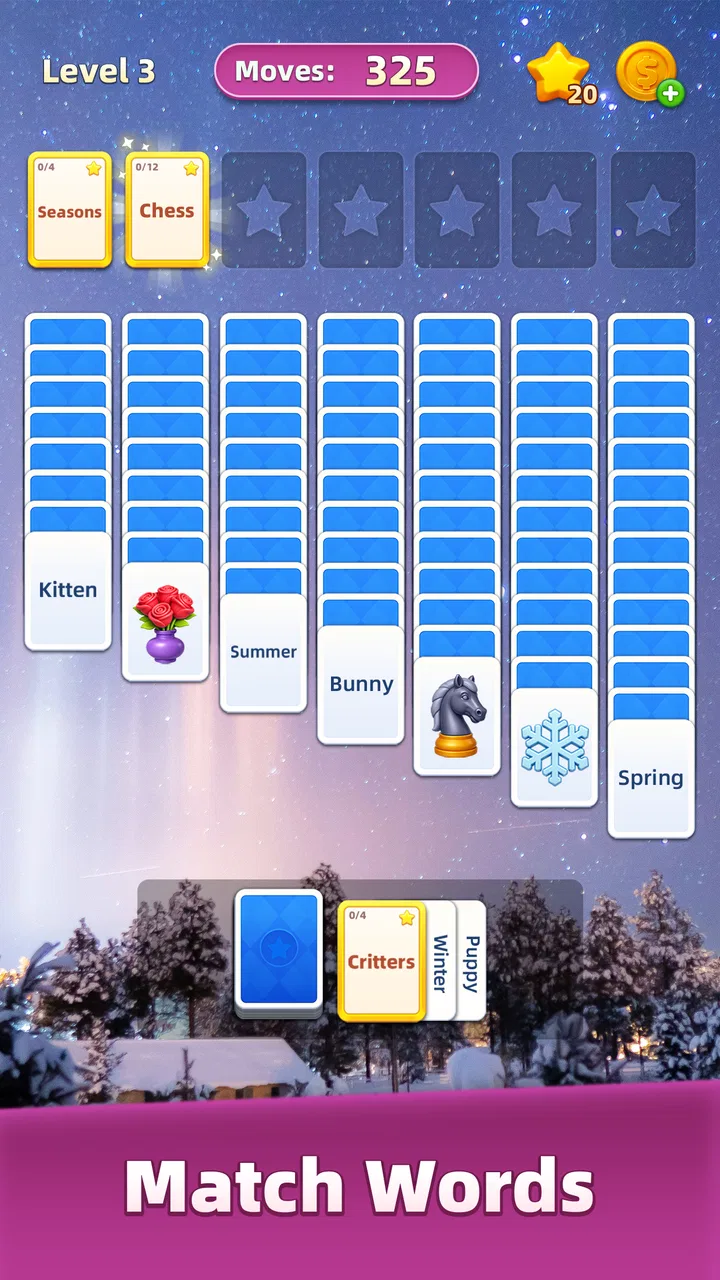
I approached Word MindSort: Solitaire expecting a light word game, but its central idea is more interesting than that label suggests. It combines word sorting with the familiar rhythm of solitaire, so each session asks me to think about language while also managing a card-like puzzle flow. That mix makes it easy to start and harder to play mindlessly, which is exactly what I want from a short mobile game.
The game is developed by TEEWEE LIMITED and is available as a free word title for Android. It is suitable for Everyone, works on devices running Android 5.0 or later, and its current version is 1.622.229. The store summary, “Word Sort meets Solitaire!”, is brief, but it does point toward the main appeal: this is not a conventional spelling quiz and not a standard solitaire clone. Its identity comes from putting those two puzzle habits together.
How the word-and-card idea feels in everyday play
My first impression was that the game works best when I treat it as a concentration break rather than a long-form adventure. A quick round fits naturally into a coffee break, a commute, or the few minutes before bed. The word element gives me something to reason through, while the solitaire influence makes the session feel structured instead of like an open-ended word search.
You May Also Like

 Blood Strike: 2.5 Anniversary
Blood Strike’s Loadouts Turn Every Drop Into a Tactical Gamble
A close look at Blood Strike’s custom loadouts: how fast access to signature weapons reshapes its battle royale rhythm, rewards preparation, and narrows the gap between fights.

 Pandora - Music & Podcasts
Pandora’s Music Is Easy to Start, but Harder to Recover
Pandora’s strength is its low-effort path from a seed to a station. Its weak spot is how much confidence it asks you to place in connection, setup, and quiet recovery.

 8 Ball Pool
 Is Built on Rivalries, Rematches, and Routine
A close look at the rivalries, rematches, shared routines, and unanswered safety questions that turn a quick pool match into a persistent mobile community.

 Samsung Music
’s Quiet Strength Is Playing What You Already Own
Its reach comes less from spectacle than from dependable access to a personal library. That simplicity is both the app’s strongest retention engine and its ceiling.

 AccuWeather: Weather Radar
AccuWeather Review: A Quick, Clear Forecast for Everyday Decisions
For everyday plans, the best forecast is the one you can understand quickly. AccuWeather makes rain timing, radar, and local conditions easy to act on, with a few trade-offs.

 Hill Climb Racing
Why Hill Climb Racing Still Turns Crashes Into One More Run
A tiny car, a bumpy hill and one more upgrade: Hill Climb Racing keeps resurfacing because its simple chaos makes every near-miss feel personal.
More From Our News Desk



That combination also changes the way I make decisions. In a typical word game, I can often focus only on finding a word or arranging letters. Here, the solitaire framing encourages a second question: should I make the obvious move now, or preserve a better option for later? Even without turning the game into a complicated strategy title, that extra layer gives ordinary word recognition more consequence.
I would recommend it to players who enjoy anagrams, sorting puzzles, casual card games, and short sessions that reward attention. It is especially suitable for someone who likes the calm pacing of solitaire but wants more mental variety than simply moving cards into familiar piles. It is less suitable for players looking for a story, a large competitive community, or a deep role-playing progression system. The appeal is in the puzzle loop itself.
The game has a 4.5 average from around 12 thousand ratings, with over 100 thousand installs. Those figures suggest that the concept has found an audience, but they do not replace personal testing. What matters to me is whether the word mechanics remain readable and whether the solitaire structure adds meaningful choices instead of becoming decoration. In my experience, the hybrid concept is strong enough to stand on its own, provided you enjoy thinking carefully rather than tapping through every move.
Why the hybrid format is more than a label
The useful distinction between this game and a normal word puzzle is the feeling of sequence. A word discovery is not necessarily the whole objective; it becomes part of a broader arrangement. That makes the game feel closer to solving a small chain of decisions than completing an isolated vocabulary task.
I found that this encourages a slower first look. Instead of immediately choosing the most recognizable combination, I scan the available options and consider which move keeps the board flexible. That is one of the more valuable habits the game can teach without announcing itself as a strategy lesson. The strongest move is not always the flashiest word; sometimes it is the move that prevents the next stage from becoming awkward.
A practical tip is to pause briefly at the start of a round and identify the moves that appear to unlock the most space or possibilities. This is more useful than rushing toward the first valid answer. It also helps reduce the frustration that comes from making a legal move that later leaves an inconvenient arrangement. The game rewards a little planning, even when the session itself is casual.
Another useful approach is to play in two modes mentally. During the first pass, I look for straightforward words and obvious placements. During the second, I check whether my choice improves the overall arrangement. This simple split keeps the word-search portion from overwhelming the solitaire portion and makes the experience feel more deliberate.
Progress feels personal, but pressure can change the mood
Word MindSort: Solitaire is at its best when I use it as a low-pressure mental reset. The short-puzzle format makes it easy to stop after a satisfying solution rather than committing to a long campaign. That is valuable for players who want a game that respects irregular schedules.
At the same time, any puzzle built around sequential decisions can create pressure when an early move seems to close off later options. That tension is part of the appeal, but it can also make a relaxing session feel less relaxing if I start treating every round as a test I must perfect. My advice is to separate practice from performance: use the first few sessions to learn the game’s rhythm, then decide whether you actually enjoy optimizing each arrangement.
The free entry point makes that experiment straightforward. I can try the core experience without paying first, which is important for a niche combination like this. The game includes in-app purchases ranging from $1.99 to $99.99 per item. That is a wide purchase range, so I would approach spending carefully and decide in advance whether I am comfortable buying anything at all.
I do not see a reason to spend simply to discover whether the word-and-solitaire concept suits me. The free version is the sensible starting point. If someone later chooses to buy an item, that decision should be based on a clear personal benefit rather than pressure created by wanting to finish a particular session. My rule is simple: enjoy the free loop first, and treat every purchase as optional rather than necessary.
For parents, the Everyone rating is reassuring in terms of the intended audience, but I would still explain the purchase situation before handing the device to a child. An age rating describes suitability; it does not automatically mean that every purchase decision is appropriate for every household. I would use the device’s normal purchase controls and discuss spending expectations clearly.
What makes the game fair, and what I would watch closely
Fairness in a puzzle game is not only about competition. It also means that my decisions should matter, the rules should feel understandable, and spending should not be the only route to a satisfying experience. The word-and-solitaire format has a natural advantage here because the main challenge comes from recognizing words and planning arrangements, not from reflex speed.
That makes it a better fit for players who dislike action-game pressure or reaction-based contests. I can think through a move instead of relying on quick fingers. It also means that the game’s fairness depends heavily on how clearly it presents available choices and consequences. When the board communicates what I can do, success feels earned. When the next move feels opaque, frustration rises quickly.
I would not describe the game as a direct substitute for a traditional solitaire app. Standard solitaire is usually about card sequencing and familiar rules, while this title asks me to bring vocabulary and sorting into the decision process. Nor is it the same as a pure word game, where the goal may be maximizing vocabulary, speed, or streaks. This is a middle ground for people who want both kinds of thinking in one session.
Compared with a crossword, it is likely to feel more immediate and less dependent on clues or general knowledge. Compared with an anagram game, it offers a more organized board context. Compared with classic solitaire, it adds language-based friction. That makes it a particularly good choice for someone who has grown tired of repeating the same card patterns but does not want a loud or complicated puzzle experience.
There is also a trade-off. Players who love pure word challenges may find the solitaire structure slows down the vocabulary part. Players who love classic solitaire may find the word element interrupts the familiar flow. I think the hybrid works precisely because it does not fully satisfy either audience in the conventional way; it creates a third option. Whether that feels refreshing or distracting depends on which half of the formula you value most.
Small habits that improve the experience
One non-obvious strength is that the game can support different attention levels. When I am tired, I can focus on obvious word relationships and let the arrangement guide me. When I have more time, I can examine the consequences of each move and try to solve the board more elegantly. That flexibility gives the same basic format more longevity than a puzzle that only works when I am fully focused.
I also recommend avoiding sessions that are too long if the game starts to feel repetitive. Because the core loop is compact, stopping after a few successful rounds can preserve its freshness. The title works well as a pocket-sized activity; it does not need to become the only game on my phone. This is a useful distinction for anyone who wants a reliable break rather than an all-day progression treadmill.
A second tip is to use mistakes as information instead of immediately blaming the puzzle. If a move leaves me with poor options, I try to remember what kind of arrangement caused the problem. Over time, that builds a personal sense of which choices are flexible and which are risky. The learning comes from comparing outcomes, not merely from searching for the fastest answer.
A third tip concerns vocabulary. I would not use the game as a formal language-learning tool, because its main purpose is entertainment and the exact learning structure is not the reason to install it. Still, players who enjoy noticing word patterns may find that repeated sorting encourages them to recognize familiar letter groupings more quickly. That is a pleasant side effect, but I would not expect it to replace a dedicated vocabulary app.
Questions worth considering before installing
If you are wondering whether it works offline, I would avoid making that assumption before testing it on your own device. A puzzle that looks simple can still depend on parts of the app experience that are not obvious from a short description. I would install it while connected, open several rounds, and then check how it behaves when connectivity is unavailable before relying on it for travel.
If you are asking whether it is suitable for children, the Everyone rating makes it broadly accessible, and the word format is more thoughtful than many purely reflex-based games. I would still supervise spending settings and consider whether the child enjoys word manipulation. A child who wants action or visual exploration may lose interest quickly, while a child who likes sorting and language could find the format appealing.
If you are unsure whether purchases are needed, my answer is no for the initial trial. It is free to start, and the purchase range from $1.99 to $99.99 per item means I would not tap through any offer casually. I would first decide whether the basic puzzle loop holds my attention over several separate sessions. That is a more reliable test than enjoying one lucky round.
If you want a serious competitive word game, I would choose a title designed around head-to-head play, rankings, or timed vocabulary challenges instead. This game is better for private concentration and casual problem-solving. Likewise, if you want a faithful recreation of classic solitaire, a traditional solitaire app will probably feel cleaner and more predictable.
Finally, if you are concerned about device compatibility, the minimum requirement is Android 5.0 or later, so the stated operating-system floor is relatively accessible. I would still check how smoothly it runs on an older phone, especially if the device has limited storage or memory. Compatibility on paper is useful, but comfort during play depends on the individual device.
My trust verdict after weighing the trade-offs
The developer, TEEWEE LIMITED, has built a game around a clear and understandable premise rather than hiding the central idea behind a complicated genre label. The free price makes it easy to explore, the Everyone rating broadens its audience, and the current version shows that the product is being presented as an active app rather than an abandoned experiment.
My trust is strongest when I judge it as a focused casual puzzle. I know what kind of experience I am choosing: word sorting shaped by solitaire-style decisions. I would be more cautious about treating it as a complete long-term hobby until I had personally decided that the available variety and progression kept me interested. That is not a criticism of the concept; it is a reminder that a simple loop must match the player’s expectations.
The purchase information is the main reason I would keep spending disciplined. A free download is welcome, but the presence of items across a broad price range means I would not confuse accessibility with unlimited value. I would play first, set a budget if I later wanted extras, and stop if the game began making the purchase feel more important than the puzzle.
Overall, I would recommend Word MindSort: Solitaire to anyone who wants a calm but thoughtful word game with a card-puzzle backbone. I like that it asks me to balance immediate word recognition with the consequences of arrangement, and I appreciate that it fits naturally into short breaks. I would skip it if I wanted competitive word battles, a rich story, or completely traditional solitaire. For the right player, though, this unusual blend is exactly what makes it worth trying.
FAQs for Word MindSort: Solitaire
01What is Word MindSort: Solitaire and how does it work?
Word MindSort: Solitaire is a unique blend of word puzzle and solitaire games. Players must organize cards to form words, challenging their vocabulary and strategic thinking skills. The objective is to clear the board by creating valid words, which helps improve language skills while providing a relaxing gaming experience.
02Is Word MindSort: Solitaire suitable for all age groups?
Yes, Word MindSort: Solitaire is designed to be accessible and enjoyable for players of all ages. Its interface is user-friendly, and the difficulty levels can be adjusted to suit both younger players and adults. This makes it a great educational tool for children while remaining challenging for seasoned gamers.
03Does Word MindSort: Solitaire require an internet connection to play?
Word MindSort: Solitaire can be played offline, making it a perfect option for on-the-go gaming without worrying about data usage. However, an internet connection is needed for initial download, updates, and accessing certain features like leaderboards and special events to enhance your gaming experience.
04Are there any in-app purchases in Word MindSort: Solitaire?
Word MindSort: Solitaire offers in-app purchases for items such as hints or additional levels. While the game itself is free to download, these optional purchases can enhance gameplay and help players progress faster. Players can still enjoy a full experience without making any purchases.
05What are the system requirements for Word MindSort: Solitaire?
For Android devices, Word MindSort: Solitaire requires Android 5.0 (Lollipop) or higher. For iOS devices, iOS 11.0 or later is needed. The game is optimized for both smartphones and tablets, ensuring smooth performance and an engaging experience across all devices.
Pros
- Engaging solitaire-style gameplay
- Visually appealing design
- Challenging puzzles for all levels
- Smooth and intuitive interface
- Offline play available
Cons
- Limited free levels available
- In-app purchases can be costly
- Ads can be intrusive
- Requires frequent updates
- Limited customization options

Word MindSort: Solitaire
Gallery